
Opening Doors: Through the Voices of The Academy
Introduction
Since 2005, Connection Crew CIC has worked to create opportunities for people affected by homelessness through training and meaningful work in the events industry. Over the past two decades, the organisation has serviced thousands of events while training and employing hundreds of people - including those currently living in temporary accommodation, those at high risk such as individuals leaving institutions, and those who have experienced long-term unemployment.
The Academy was built on this foundation, offering a structured pathway for people affected by homelessness to develop skills, confidence, and access to fulfilling careers. First piloted in 2015, it responded to a clear need for more preparatory support: people referred through homelessness charities in some cases arrived unprepared for the physical and emotional realities of crewing. The Academy became the bridge - a space to develop before stepping into the high-pressure environment of live site work.
Through the voices of Academy alumni, trainers, referrers and wider staff, this piece reflects on the impact of the Academy, the lessons learned, and the ways Connection Crew and the events industry could go further to support those facing barriers to stable employment.
Overcoming Barriers to Work
For people experiencing homelessness or for those at risk, securing stable employment is rarely simple. Housing instability, stigma, gaps in employment history, and health challenges can make it extremely difficult to compete. Many face a crisis of confidence before their first interview.
Jermaine, now an Academy alumnus working in Stitch – the production arm of Connection Crew, recalls: “A challenging situation led to a deep depression. I’d always been self-employed and worked in an isolated way. My depression meant I had almost become a hermit. I remember my doctor telling me, ‘You’re a sociable person, but you don’t work as one.’ That really hit home.” Shelter referred him because of his housing instability. He describes feeling instantly welcomed: “I’d always been my own boss, but I needed to find a company where the values matched mine - fair, human, approachable. That’s what I found here.”
Jae, another graduate, had faced crises that affected his mental health: “I had a massive breakdown and barely left the house for a year. My Universal Credit work coach was amazing and took time to talk through my options. I told him I’d always been interested in events, and he referred me into the Academy. Everything changed from there.”
Reuben discovered Connection Crew nearly a decade ago after a period of homelessness and struggles with addiction. “I’d been sofa surfing and then street homeless around Birmingham for close to a year, with addiction at the centre of it. An overdose and a hospital admission became the turning point. I moved to London for a fresh start and found Connection Crew. From there, everything changed for me.”
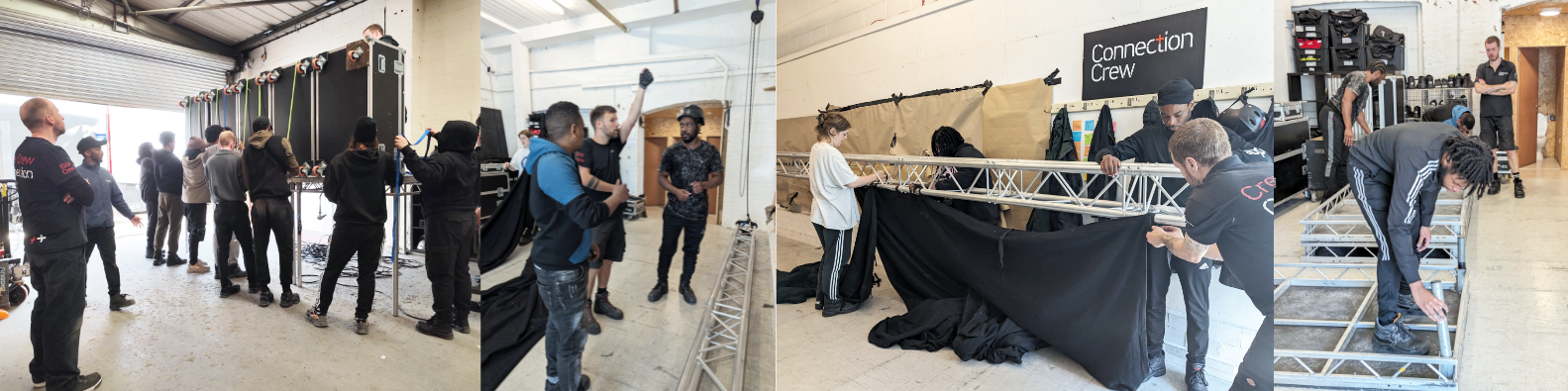
Photos from the August 2023 Academy, with Reuben and Gren training.
Gren, Crew Chief and trainer, confirms that many recruits arrive with potential but daunting challenges: “Some come from prison, or unstable housing. Others might be coping with language barriers. The important part is making sure they don’t feel isolated - that they’re included on site.”
Juliet, an Employment Broker at Crisis, adds: “Trauma and mental health are common, particularly for people who’ve experienced or are at risk of homelessness. Health conditions can also be significant. When people reach our team, they’re, for the most part, on a work-ready track, with their lead worker still providing some support. Working with employment programmes like Connection Crew means we can offer flexible and adaptable support for those re-entering the workplace.”
The Academy: Learning, Mentoring, Thriving
The Academy runs a three-day programme, preceded by taster sessions and followed with mentoring. Day one introduces crewing culture and skills. Day two covers practical knowledge – from setting up AV and staging, to safe lifting. The final day concludes with a “test build,” testing teamwork and communication.
Margarita, Senior Comms Manager, explains: “Learning crewing skills is vital, but just as important is the chance to work as a team and build confidence.” Initially two weeks long, the course was shortened after feedback showed some participants disengaged. “We found that a shorter, sharper programme worked better,” says Margarita. “We added a taster session because crewing is challenging and it isn’t widely understood - people needed to see if it was for them. We also introduced mentoring to ensure continued support whilst trainees were on their first jobs.”
Juliet highlights the Academy’s appeal for young people: “It’s exciting and different, they get to go to all these venues, they’re on the move - and it’s flexible so it can work with their benefits or Universal Credit.”
Mentoring is central - it supports graduates, develops mentors, and fosters a culture of teamwork and positive communication. Gren says, “It’s satisfying to work with somebody closely and see them blossom. I was working yesterday with my first mentee from three years ago - he’s thriving.” Margarita adds: “Having a buddy gives people confidence in those first jobs, when everything could feel overwhelming.”
The Impact: Confidence, Skills, and Community
Juliet from Crisis emphasises: “Work builds stability, confidence, and a stronger CV. People gain teamwork, time management and organisational skills. For some, crewing could be longer-term; for others, it’s a stepping stone, with income at the London Living Wage helping financial resilience.”
Graduates describe openness and authenticity from trainers and mentors. “You are actively encouraged to ask questions,” says Jae. “Questions are key to being safe. It’s not just about learning how to build a stage or about health and safety. It’s part of the working culture here - supportive and open.”
Jermaine reflects: “Before working here, I barely left the house. Now I go out more, I train, I connect with people - I’m a different person.” He speaks warmly of friendships formed: “Those conversations after shifts, sharing struggles around wellbeing, family and money - knowing I’m not alone has been a massive boost.”
Jae’s story is intergenerational: “My son saw the amazing things I was working on, and eventually he joined up himself. We’ve even worked together at Notting Hill Carnival. He loves it.”
Reuben: “They gave me a career and a community. They trusted me, challenged me, and let me be myself. Connection Crew was the central pillar in my sobriety and my professional growth.”
Mentoring is key. Gren says: “Seeing someone go from nervous and quiet to confident and competent is powerful. The idea is that on day one they’re no different to any other crew member - they’ve earned their place. And when I see them later, thriving on site, that’s the best reward.”
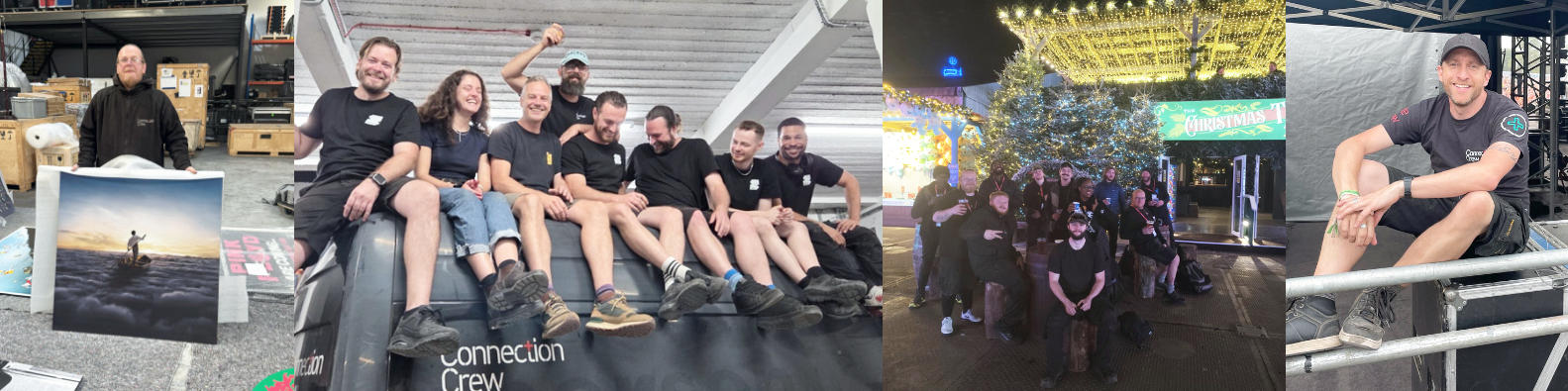
L-R: Jae at the Pink Floyd exhibition, Jermaine with the Stitch team, Jae at the Winter Wonderland, Gren with the stage crew
Lessons Learned: Adapting and Reflecting
Margarita emphasises pacing: “You can’t set people up to fail - even when they’re enthusiastic, the stakes are high for them, so it’s important to go at an appropriate pace, work closely with partners and make those calls.”
Gren notes: “If a trainee has extremely high needs and requires more one-on-one support, we might not be able to support them appropriately. Language barriers can be another, but we adapt and always try to be inclusive. The most important thing is making sure trainees don’t feel isolated.”
Reuben adds: “The hardest moments were when someone clearly had the attitude and capability, but their external situation - no fixed address, rehab constraints, unstable housing - meant they weren’t ready for live sites. Saying ‘not yet’ while keeping the door open is painful but necessary. On the flip side, watching people come out of their shells is unbeatable.”
Gren stresses professionalism: “We tell recruits - every day is a first impression. You’re working for the client, not just for us. Be on time, be presentable. That’s what builds trust.”
Industry Call to Action: Fairness, Inclusion, Sustainability
Margarita points out challenges of the job: “If it’s 2am and you’re on a build at a posh hotel, miles from a regular shop, crew might be forced to buy overpriced hotel water and unhealthy snacks, so we’re encouraging more clients to ensure sites are inclusive and accessible.”
Reuben is clear: “Welfare first. Feed people, keep them dry, provide water and a proper base. Also, keep teaching and develop your crew. Stop pretending there’s ‘no time’. There is. Build mentoring and micro-lessons into the work. When you invest in people, you get loyalty, better safety, and better events.”
Gren emphasises the importance of open mindedness and inclusivity: “Everyone has a background, skills and potential, even if they’ve had setbacks. At Connection Crew, we don’t ask for CVs or degrees. We say: show us what you can do, and we’ll give you a chance.”
And it’s not just good for the candidates, as Juliet points out: “Employment programmes like the Academy are so important in supporting people back into work - but they also benefit the industry. You access motivated talent. Many members - including refugees with right to work - just need a fair chance.”
Margarita highlights that social and environmental responsibility go hand-in-hand: “Connection Crew is about people, but we’re also committed to reducing carbon and event waste too. We’ve introduced a small ESG levy for clients that offsets carbon from crew travel, food and kit, and we’re encouraging behaviour change like cycling to work. We have to connect all the strands of sustainability, so they reinforce each other.”
Looking Ahead: Building Sustainable Careers
Margarita shares Connection Crew’s ambitions for the Academy to deepen its support package in the future: “That could mean more wrap-around measures like travel cards, lockers or laundry facilities, and continuing to create and develop career pathways through partners. We’d also like to look further into Living Hours, where appropriate, and tailored contracts. Even though it’s already a London Living Wage job with progression, surviving in London is tough - so the aim is to build support that makes the work more sustainable.”
Reuben reflects on the importance of on-the-job learning: “Events are time- and pressure-driven. The tech is getting more advanced, but we don’t always invest enough in developing the next technicians. We should keep teaching on site, even under pressure. Warehouses and down days are perfect for continuation training - simple, structured sessions: safe two-person lifts, common cabling and connectors, basic staging components, practical safety. Many of us are visual learners; repeat exposure locks it in. It’s safer and it builds careers.”
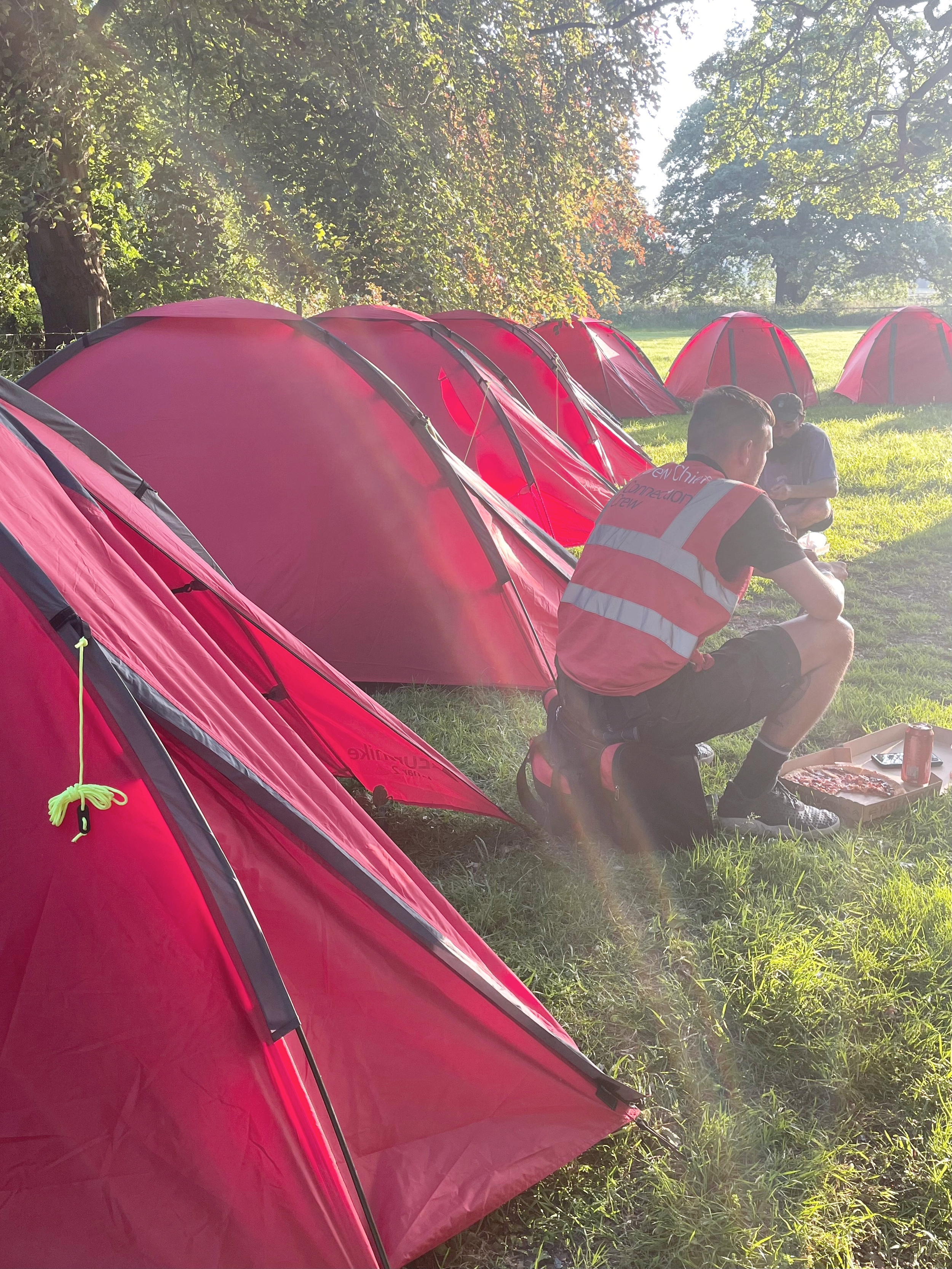
Crew Chief, Reuben at Connection Crew’s camp at Duran Duran @ Castle Howard
Closing Note: People, Purpose, Connection
It’s clear from the voices of those involved with Connection Crew that it’s an inclusive, human, and proudly people-first place to work. As Margarita puts it: “Crewing itself makes the Academy unique. It’s a job people don’t always know about, but there’s huge satisfaction and therapy in transforming a blank space into a experience with a team. But the training, mentoring, extra support and our diversity set us apart. We’ve not been great at sharing the crew or Academy experience in recent years and we need to do better going forward – watch this space.”
Certain words keep surfacing: community, diversity, people, transparency. They speak to “connection” - and to a culture that lives up to its name.
Jermaine captures the ethos: “From the start, the trainers emphasise respect, understanding, and bringing down barriers. Josh, one of the trainers, told me: ‘The best way to break barriers is to take the mick out of yourself.’ That sets the tone - everyone’s on the same level.”
Jae echoes him: “It’s how they treat people. Skills matter, but so do people skills. Everyone is welcomed, respected andsupported.”That culture builds solidarity - and opens doors to extraordinary work. “Some of the places we get to work are unbelievable. I’ve been to Creamfields. It keeps my mind active. I feel alive again.”
Gren adds: “One day you’re at the Shard, the next at a theatre or film studio. Sometimes it’s glamorous, sometimes you’re in a loading bay - but you see behind the scenes of amazing places.” The community forged on site is carried off site. “I’ve made friends for life here,” says Jermaine. Gren agrees: “We spend 10, 12 hours a day together on site. It’s a unit. That’s what makes it work.” Dedication follows this: “When companies give people time and patience, the loyalty you get back is incredible,” Jermaine reflects.
Reuben - now a tour manager - books Connection Crew for his own shows: “I’ve booked them for four shows this year. I know I am going to get a great service from them.” Margarita adds here: “This isn’t about taking credit though. We’re lucky to have a diverse team bringing varied experience and strengths to helping deliver events.”
For Reuben, the culture is visible in the smallest details: “At Creamfields, Connection Crew camped with their tents in a circle. They ate together, travelled together, took breaks together. For a massive, technically complex festival, that unity really matters.” The same spirit runs through the day-to-day: “Directors show up, the office door is open, and you’re treated like a human being. We ran our trainings with a serious stance on respect, inclusion, and humour that breaks barriers - ‘we build each other up.’ That psychological safety makes learning possible.
As a crew chief I used to say: if someone’s struggling, we’re all struggling; we go in together. Crew aren’t ‘the bottom’ — they’re the glue. Look after them, keep training them, and the whole industry gets better.”
Taken together, these voices show what’s possible when an industry takes responsibility for its people and its planet. Investing in people, mentoring, and creating inclusive, supportive environments benefits crew, events, and the wider industry.
This feature and the interviews that informed it and our Theory of Change were conducted and brought together by an independent researcher and writer with experience of working in the homelessness sector, Tamsin Clements.